
KabaddiKabaddi Champions League Expands to 10 Teams and a Rs 5 Crore Purse — But the Real Story Is PKL's Broadcast Crisis
Kabaddi Champions League Expands to 10 Teams and a Rs 5 Crore Purse — But the Real Story Is PKL's Broadcast Crisis
कबड्डी चैंपियंस लीग ने दूसरे सीज़न में टीमों की संख्या 8 से बढ़ाकर 10 कर दी है और हर फ्रेंचाइजी को नीलामी के लिए 5 करोड़ रुपये का बजट दिया है। लीग की सभी 10 टीमें हरियाणा के शहरों से हैं, यानी यह क्षेत्रीय अर्ध-पेशेवर लीग है, राष्ट्रीय प्रतियोगिता नहीं। नीलामी में सबसे ऊंची कीमत आयन लोचब (17.4 लाख रुपये) की रही, जबकि 'एशियाई खेलों के कप्तान' बताए गए सुनील मलिक 10 लाख रुपये में बिके — यह तमगा स्वतंत्र रूप से सत्यापित नहीं है। सेंट्रल ट्रायल्स में 6,400 से अधिक रजिस्ट्रेशन हुए और 300 से अधिक खिलाड़ी नीलामी पूल में पहुंचे। लेकिन असली संकेत यह है कि प्रो कबड्डी लीग (PKL) का 13वां सीज़न प्रसारण अधिकार साझेदार न होने के कारण संभवतः जून-जुलाई 2027 तक खिसक गया है। लीग की AKFI/IKF मंजूरी, खिलाड़ी अनुबंध, एंटी-डोपिंग नियम और प्रसारण-प्रायोजन राजस्व की कोई जानकारी नहीं दी गई है, इसलिए विस्तार के दावे को अभी प्रचारात्मक मानना चाहिए।
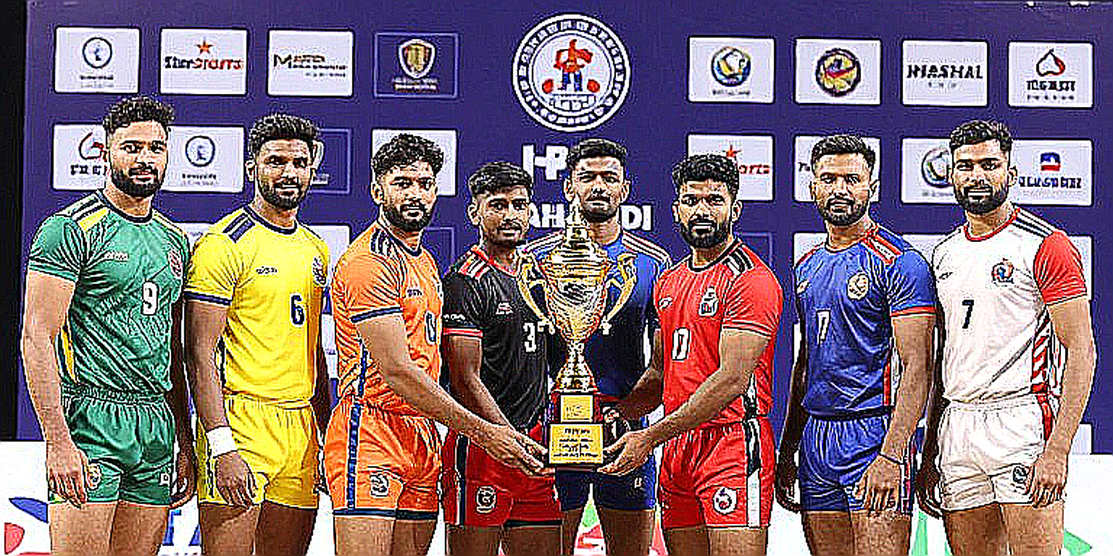
The Kabaddi Champions League, played in Haryana, has announced a significant expansion for its second season: the number of teams has gone up from eight to ten, and every franchise has been allotted an auction budget of Rs 5 crore. The league says this gives teams 'greater scope to assemble their squads' and widens the tournament's reach. But reading this announcement in isolation shows only half the picture. The same report notes that the Pro Kabaddi League (PKL) — India's flagship professional kabaddi competition — has reportedly pushed its 13th season to June-July 2027 because it currently has no broadcast-rights partner. That is not a scheduling detail. It is a structural signal for the entire Indian kabaddi ecosystem.
The league's name sounds national and even international, but its ten franchise cities tell a different story: Bhiwani, Rohtak, Karnal, Gurugram, Sonipat, Panipat, Faridabad, Hisar, Jhajjar and Kurukshetra. All ten are in Haryana. Not a single team comes from Maharashtra, Punjab or southern India. The brand borrows the halo of European football's Champions League, while its actual footprint is a Haryana district-level kabaddi circuit.
Before any economic assessment, the Rs 5 crore figure needs to be read correctly. This is not prize money; it is the squad-spending budget per franchise for the player auction — roughly US$600,000. For comparison, a single PKL franchise's typical auction outlay has historically been several multiples of that. Second, the report never clarifies whether Rs 5 crore is per team or a league-wide figure. The phrase about 'greater scope to assemble their squads' suggests per franchise, but the ambiguity materially limits how the number can be interpreted.
The auction data says more about the market than about the sport. The highest-priced player was Ayan Lochab at Rs 17.4 lakh, while Sunil Malik — described as 'India's Asian Games captain' — went for just Rs 10 lakh. In the PKL, star raiders command upwards of Rs 1 crore, which means the Champions League's price ceiling is roughly one-sixth of a single PKL star's top valuation. The Malik case creates an internal contradiction: if he really is a national-team captain, Rs 10 lakh is remarkably low. The 'captain' label could refer to a past edition or to the Circle Style variant, or it could simply be a reporting error. No independent verification exists, so it should be treated as a claim, not a fact.
According to the organisers, more than 6,400 players registered for the central trials, of whom 300-plus made the auction pool. That is genuinely impressive and reflects the depth of Haryana's rural sports economy. But reading it as the league's popularity is a mistake. A trial crowd measures rural youth chasing scarce sporting opportunity, not viewer demand. In sports business, that distinction is fundamental — and it is the classic signature of early-stage Indian leagues: supply mistaken for demand.
The most important structural signal in this report is buried in the fourth paragraph, not the headline. The PKL's next season may slip to June-July 2027 because its existing broadcast partnership has lapsed and no replacement has been named. Kabaddi is a sport that lives on television and digital ratings; the PKL's 2026 rise pulled kabaddi out of the village akhada and onto household screens precisely because of that media power. If that broadcast chain breaks for a season, the damage is not merely to the calendar — sponsorship, advertising, player incomes and the national-team pipeline all sit downstream of it.
That is the lens through which the Champions League's expansion should be read. When the flagship league is dormant, a regional league adding teams looks like momentum in itself. Strategically it is also sensible: moving first into an empty field gives access to idle talent. But presenting it as evidence that kabaddi is getting stronger is misleading. This is opportunism and gap-filling, not proof of a healthy market. The moment the PKL returns, the Champions League is likely to revert to its natural place as a feeder competition, and its expansion may prove a one-season artifact.
There is also a major governance question. It is not clear whether the league is sanctioned by the Amateur Kabaddi Federation of India (AKFI) or any other recognised body. If it is unsanctioned, players could face eligibility complications for national-team selection — a serious risk, especially for anyone claiming international credentials. Player contracts, anti-doping rules, referee standards and the rule variant in use (Standard or Circle Style) are all unmentioned. Silence on every one of those points is the signature of an early-stage, under-institutionalised competition, and it is the league's biggest governance exposure.
Commercially, hard information is close to zero. There is no broadcast deal, no sponsorship, no attendance figure, no ticket data and no revenue disclosure. That means the jump from eight to ten teams and the Rs 5 crore purse are both proceeding without any evidence on the income side. If the budget is being funded by franchise owners' pockets or a promoter's subsidy rather than earned revenue, it is not a sustainable model. India's non-cricket leagues have a strict history on this point: without broadcast income, leagues tend to shrink within two or three seasons.
Haryana is no accident. The state is regarded as India's sports nursery, with a wrestling and kabaddi tradition that runs out of the akhadas. The dream of moving from a mud training ground to a contracted athlete is the social fuel behind 6,400 trial registrations. In Haryana, government jobs and sports quotas have long been the traditional livelihood base for athletes; against that backdrop, a league paying Rs 10-17 lakh at the top end will be part-time income for most players, not a full profession. The social-mobility narrative is authentic, but there is no evidence yet that the league actually improves livelihoods.
Two risks sit at the top of the list. First, the PKL broadcast crisis: if it drags on, the entire professional layer suffers and no regional league can fill that void. Second, the opacity around this league's sanctioning and player eligibility. Behind those come the absence of any performance statistics, the absence of revenue information, and the impression created by the 'Champions League' name that this is a national-tier event.
What should be tracked from here? First, PKL's new media-rights deal. Second, whether the Kabaddi Champions League secures AKFI or IKF sanctioning. Third, any broadcast or digital rights deal for the league itself — that would most decisively validate or puncture the expansion claim. Fourth, verification of Sunil Malik's 'Asian Games captain' label against official rosters. And fifth, any hard attendance or revenue figure from season two.
The conclusion is straightforward. The Kabaddi Champions League's expansion is real, but small and confined to Haryana. It is good news for Indian kabaddi because it gives players a field and a stage. It is not evidence that the sport is commercially robust. The real story is the one missing from the headline: the country's flagship kabaddi league has no broadcaster, and its next season is drifting almost a year out. Until that question is resolved, calling any regional expansion 'momentum' is premature.
संबंधित खिलाड़ी
लोकप्रिय/पसंदीदा पुस्तकें
Kabaddi Champions League Expands in Haryana, but PKL’s Broadcast Crisis Is the Bigger Story2026-11-18
The 30-Second Clock and the Empty Stand: What Nobody Is Counting Before India vs England in Ahmedabad2026-11-13
Commonwealth Kabaddi Championship 2026: India Beat Uganda 44-30, but Defensive Questions Remain2026-11-09
A ₹5-Crore Purse, a ₹17.4-Lakh Star: The Kabaddi Champions League Bulletin With No Broadcaster In It2026-11-09
38-29: The Ahmedabad Night the Scoreline Remembered Wrongly2026-11-09
Commonwealth Kabaddi Championship 2026: Surjeet Singh to Lead India as Naveen Kumar Takes Vice-Captaincy2026-11-09
अनुशंसित
Surjeet Singh Captain, Naveen Kumar Vice-Captain: Three Questions the Commonwealth Kabaddi Championship Release Cannot Answer2026-10-22
13 Nations, 62 Matches and One Missing Name: The Real Ledger of the Commonwealth Kabaddi Championship2026-10-22
India vs Uganda, Match 9 of Commonwealth Kabaddi Championship 2026: Three Questions Hidden Behind a Big Win2026-11-02
62 Matches, 13 Nations and One Missing Name: The Real Scoreboard of the Commonwealth Kabaddi Championship2026-10-22
The 30-Second Clock and the Empty Stand: What Nobody Is Counting Before India vs England in Ahmedabad2026-11-13
Surjeet Singh Captain, Naveen Kumar Vice-Captain: The Commonwealth Kabaddi Championship 2026 Announcement That Leaves Three Questions Unanswered2026-10-22
Commonwealth Kabaddi Championship 2026: Surjeet Singh Named Captain, Naveen Kumar Vice-Captain — The Decision That Will Be Written on the Mat2026-10-22
Fourteen Names on the Sheet, Thirteen on the Mat: What Pakistan's Late Withdrawal Cost the Commonwealth Championship2026-10-22
अनुशंसित
Commonwealth Kabaddi Championship 2026: The Captaincy Announcement Is Missing the One Document That Actually Matters2026-10-22
The 30-Second Clock and the Empty Stand: What Nobody Is Counting Before India vs England in Ahmedabad2026-11-13
Kabaddi's Two Ledgers: Where Pro Kabaddi Form Ends and the Asian Games Begin2026-11-15
Before Writing a Major Kabaddi Report, One Essential Question Remains: Where Are the Original Facts and Figures?2026-11-07
Commonwealth Kabaddi Championship 2026: Surjeet Singh Captain, Naveen Kumar Vice-Captain—But the Archive Hasn't Named the Team Yet2026-10-22
Kabaddi Champions League Expands to 10 Teams on a Rs 5 Crore Purse, With a Stalled PKL in the Background2026-11-07
अनुशंसित
Surjeet Singh Captain, Naveen Kumar Deputy: What Will Truly Test India Before the Commonwealth Kabaddi Championship?2026-11-07
Kabaddi Champions League Expansion: Ten Teams, a Bigger Purse and Unanswered Questions for the PKL2026-11-10
The Strategy Ledger: PKL Auction's Rs 1.65 Crore Bid and the Empty-Stadium Math2026-11-03
Fourteen Names on the Sheet, Thirteen on the Mat: What Pakistan's Late Withdrawal Cost the Commonwealth Championship2026-10-22
38-29: The Ahmedabad Night the Scoreline Remembered Wrongly2026-11-09
An Empty Dataset Cannot Produce a Kabaddi Report: Stage-1 Failure Exposes the First Weakness in Analysis2026-11-13
Before Writing a Major Kabaddi Report, One Essential Question Remains: Where Are the Original Facts and Figures?2026-11-07
Ahmedabad's Paper Round: 62 Matches, 13 Nations and the Column Nobody Was Meant to Read2026-10-22